

Best Warehouse Management Software - A Buyer’s Guide
In addition to tracking stock quantities, the best warehouse management system must help your employees handle order receiving, locating products, picking, shipping and maintaining inventory accuracy as you grow.
If you have a small manufacturing business, warehouse inventory management may require barcoding and multi-location inventory management solutions. If you run an online store, then you probably need to integrate with Shopify and automate fulfilment process. A 3PL business needs client portals and invoicing, whereas an enterprise-scale company needs robotics, labor management and AI-driven WMS solution.
This buyer’s guide is a comparison of five best warehouse management systems for various industries.

Methodology
We studied their respective capabilities for warehouses and inventory management, their pricing model, scalability and suitability of the system for various business models. Customer reviews from Trustpilot were also studied wherever available.
We evaluated these WMSs based on the specific type of business they can be used for instead of evaluating them interchangeably.
The best warehouse management software compared
| Software | Best for | Starting price |
|---|---|---|
| Unleashed | Inventory and warehouse management | $399/month |
| Zoho Inventory | Small businesses | $29/month |
| Mintsoft | 3PL and ecommerce operations | £159/month |
| Veeqo | Low-budget warehouse and shipping operations | Free |
| Manhattan Active WMS | Large enterprises | Custom |
Best for inventory and warehouse management: Unleashed
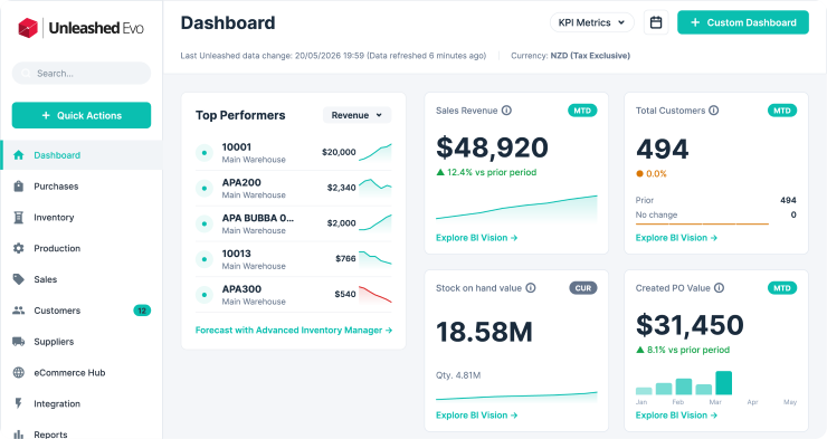
Unleashed is built around inventory management for product-based businesses, with warehouse management sitting alongside purchasing, sales and production.
Pricing: From $399/month for Core, paid monthly
User rating (Trustpilot): 4.7/5 (+1,200 reviews)
Free trial: 14 days
Why it's best for inventory and warehouse management
Unleashed software makes sense when warehouse management is tightly connected with purchasing, production, and inventory control.
The Core package includes: multi-warehouse management, warehouse transfer, stock control count, multiple units of measure, stock alerting, batch/serial number management, landed cost and stock adjustment.
The Warehouse Management and Multi-Bin module incorporates mobile first picking, packing, receiving and transferring, where barcode scanning is done on a mobile device (smartphone or tablet).
Consider a furniture manufacturer keeping finished goods in Birmingham and raw materials in Manchester. A Warehouse Manager is able to manage stock in each warehouse without using separate spreadsheets, and purchasing and production people work from the same stock information.
Pros
- Strong combination of inventory, purchasing, sales and warehouse functions
- Multi-warehouse and batch/serial tracking
- Mobile warehouse tools and barcode scanning available
Cons
- Core warehouse functionality beyond inventory management can require additional modules
- Starting price is considerably higher than lightweight inventory tools
- Additional users, integrations and order capacity can increase the monthly cost
Best warehouse management system for small businesses: Zoho Inventory
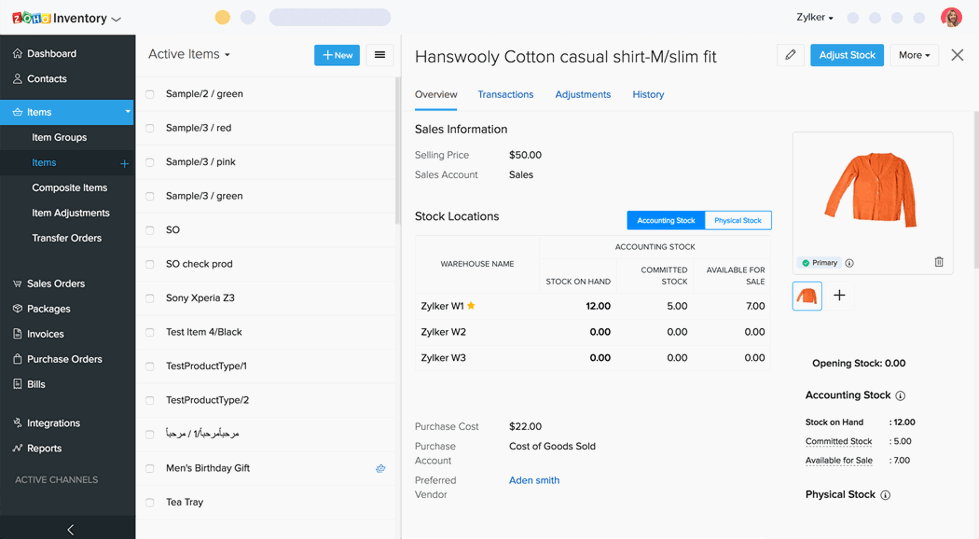
Zoho Inventory is aimed at businesses that need inventory, order and warehouse management without investing in a large enterprise WMS.
Pricing: Free plan while paid subscriptions start at $29/month, billed annually
User rating (Trustpilot): 3.8/5 (+6,000 reviews)
Free trial: 14 days
Why it's best for small businesses
It's relatively inexpensive access along with functional warehousing.
Even the entry-level plan offers capabilities like ordering and order management and management across multiple warehouses. Higher tiers have functionalities such as serialisation and batching, barcode labeling, stock counting and increased warehouse space.
For example, take an electrical wholesaler who sells online from its website and Amazon and offline using a trade counter. Rather than updating stock levels in three separate places, Zoho Inventory can link sales channels and consolidate inventory information.
Pros
- Low starting price
- Multi-warehouse management
- Barcode, batch and serial tracking
Cons
- Advanced warehousing is an additional paid feature
- Lower plans have relatively tight order, user and location limits
- Some Trustpilot feedback concerns the wider Zoho product ecosystem rather than Zoho Inventory specifically, so reviews should be treated cautiously
Learn more: Zoho Inventory vs Unleashed
Best for 3PL and ecommerce operations: Mintsoft
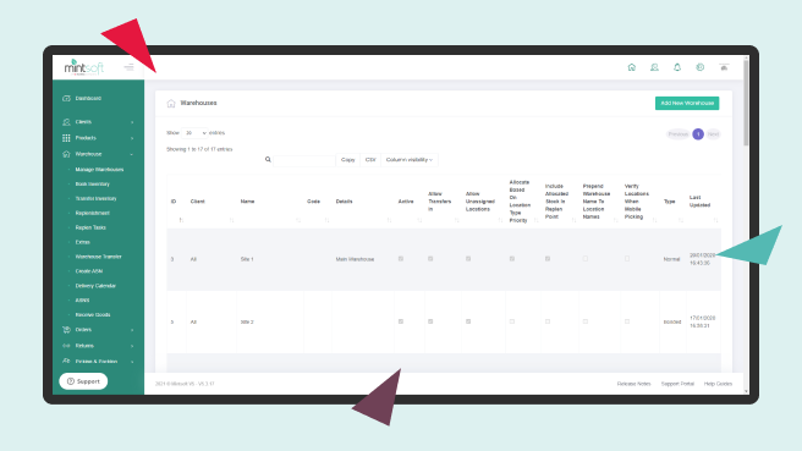
Mintsoft combines warehouse management with order management, inventory, shipping and ecommerce integrations.
Pricing: From £159/month for smaller brands and wholesalers
User rating (Trustpilot): 4.7/5 (+400 reviews)
Free trial: No
Why it's best for 3PLs and ecommerce operations
3PL plans bring together a customer portal and customer billing in addition to warehouse, order, and shipping management. The basic 3PL offering works with up to 3,000 orders a month and up to 10 customers.
For instance, the fulfilment firm could hold the skincare products of five ecommerce companies. Each of these firms would need access to its own inventory, orders, and fulfilment process information. It is difficult to do that with a general inventory system but not Mintsoft 3PL solution.
Pros
- Client portal and billing
- Strong ecommerce and shipping focus
- Warehouse, inventory and order management in one platform
Cons
- Can become expensive as order volumes increase
- Advanced functionality may require additional modules
- More than most small businesses need if they only operate a single warehouse
Best low-budget option: Veeqo
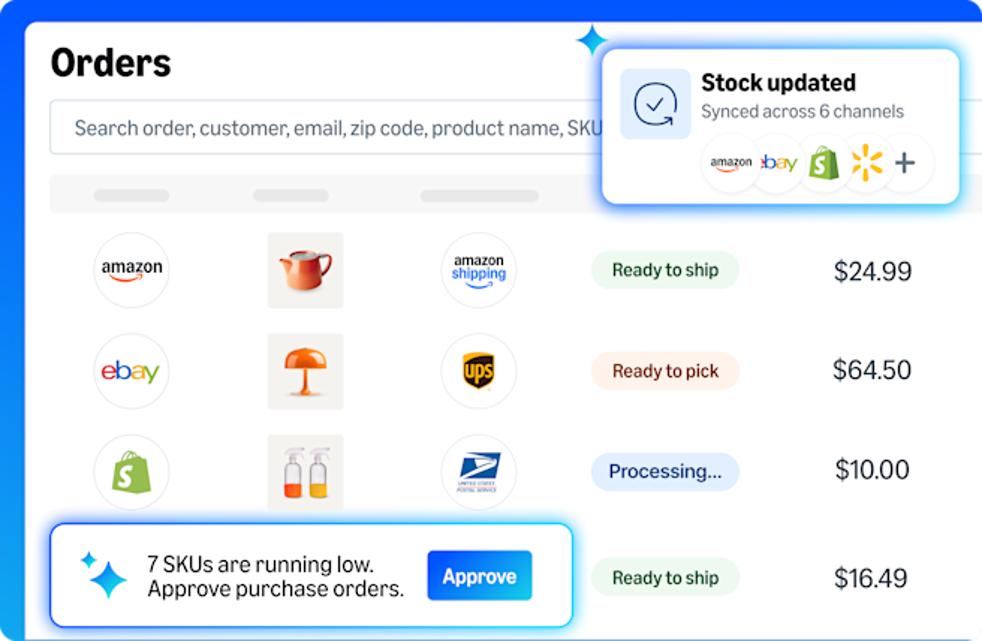
Veeqo is a quick option for ecommerce businesses that want to start with shipping and add more advanced inventory capabilities as they grow.
Pricing: The Shipping plan is free while Inventory starts from £17/month
User rating (Trustpilot): 2/5 (+300 reviews)
Free trial: Available
Why it's the best low-budget option
The Shipping plan is completely free and gives you unlimited number of users, products, SKUs, warehouses, locations, and shipments. The paid Inventory plan adds inventory synchronisation, demand forecasting, and picking capabilities like picking path optimisation.
This is a good solution only for a small online retailer who wants to consolidate shipping from multiple channels.
For instance, a clothing store that sells its products on Shopify, Amazon, and some other marketplace can use Veeqo for managing its shipments without switching between different platforms.
Pros
- Demand forecasting
- Digital picking tools
- Useful for multichannel ecommerce
Cons
- Advanced features are usage-based
- ERP integration is restricted to the High Volume plan
- Current user feedback is mixed, with complaints including product and support issues
Best for large enterprises: Manhattan Active WMS
Manhattan Active WMS is designed for significantly more complex warehouse environments than the typical small-business inventory platform.
Pricing: Custom
User rating (Gartner): 4.2/5 (+30 reviews)
Free trial: Request after demo
Why it's best for large enterprises
This system incorporates functionality for inventory, labour, automation, transport and yard management as well as a warehouse execution system which facilitates coordination between humans and robots.
This becomes very important for large scale operations as warehouses no longer rely on just the human workforce.
For instance, a large retailer may use automated storage and retrieval systems, conveyors, robotic pickers, employ several hundred people and have a couple of thousand orders each day.
Pros
- Built for complex enterprise operations
- Cloud-native architecture
- Warehouse execution and robotics capabilities
Cons
- Enterprise implementation requires significantly more planning than a small-business WMS
- Pricing is only quote-based
- Likely excessive for a single small warehouse with straightforward picking and packing requirements
What to consider before you invest in warehouse management software
Each of the choices above serve different use cases and scale so the type of business and operations you run matters most.
Here are all the other factors to take into consideration and what to pay attention to for each:
Features
Start with the warehouse problems that are costing you the most time or money. These are the ones currently halting operations or causing errors that reach customers, or even worker wellbeing.
If your main problem is missing inventory on the spreadsheet, then focus on SKU level inventory tracking, counting, and barcodes. If orders are getting picked incorrectly, consider focusing on pick lists and digital picking. If your inventory is distributed in three separate warehouses, then multi-location inventory becomes more significant.
Scalability
Before choosing, work out what happens when you double your order volume.
A brilliant approach that works when you have 500 orders per month can be restrictive at 5,000. Make sure you understand the restrictions of the system in terms of orders, users, warehouses, or SKUs, as well as how you calculate inventory turnover.
Budget
Compare the total cost of a tool and not simply the initial subscription cost which might not take into account extra users, orders or add-ons.
For example, the Core plan of Unleashed which is offered for £269/month but the Warehouse Management while Multi-Bin Module costs an extra £99/month. The free shipping plan of Veeqo comes at zero cost for the software but inventory management features sit within paid plans, meaning you can’t run your entire warehousing management operations with just the free plan.
What are your pain points
Write down the three warehouse problems costing you the most time or money.
Is your team counting stock manually? Are customers ordering products that are already sold out? Are warehouse staff walking back and forth to find products? Are purchase orders disconnected from inventory?
Your warehouse management software should solve those specific problems. More features are not automatically more useful.
Integrations
Check every system the warehouse already depends on.
That could include Shopify, Amazon, WooCommerce, accounting software, ERP systems, courier platforms, barcode scanners or warehouse automation.
A warehouse management system that can’t exchange accurate data with the rest of your operation can create another information silo.
Customer service and implementation
Warehouse software becomes part of your daily operation. If something goes wrong, waiting several days for an answer can have a direct operational cost.
Look beyond the sales demo and check:
- Onboarding options
- Training materials
- Available support hours
- Implementation services
- Customer reviews
Which warehouse management system should you choose?
There is no single best warehouse management system software for every business.
A manufacturer that needs production, purchasing and inventory in one place has different requirements from a 3PL handling thousands of ecommerce orders. Likewise, a small online retailer does not need the same infrastructure as a global distribution network.
For product-based businesses looking for a system that connects inventory with purchasing, sales and warehouse operations, Unleashed is worth exploring via a demo.
You can also use the Unleashed ROI calculator to estimate the potential financial impact for your operation.
Frequently Asked Questions
What is the most popular warehouse management software?
There is no single warehouse management system that is the most popular for every business. Unleashed is designed for product-based businesses that need to connect inventory, purchasing, sales and warehouse operations in one system. Its multi-warehouse management, stock tracking and barcode capabilities make it particularly relevant to manufacturers, wholesalers, distributors and other growing businesses.
What is the best free warehouse management software?
Veeqo offers a free shipping plan, while Zoho Inventory also provides a free inventory plan with usage limits. However, free tools typically restrict features, orders, users or warehouse capacity. Unleashed is a paid platform, but provides more comprehensive inventory and warehouse functionality for businesses that need features such as multi-warehouse management, stock counts, batch and serial tracking and barcode-enabled warehouse processes.
Which WMS does Amazon use?
Amazon doesn't use any conventional WMS that comes with third-party services but rather has created its own WMS. Amazon has created its system for its own advanced fulfilment centers, and this makes their system unique from what other product-based companies require. For growing manufacturing, wholesale, and distribution businesses, the solution for bridging inventory and warehouse processes is provided by Unleashed.
What is the best WMS software for small businesses?
The best WMS for a small business depends on its products, warehouse setup and operational complexity. Unleashed is designed for small and growing product-based businesses that need more than basic stock counts, combining inventory, purchasing, sales, production and warehouse management. Its multi-warehouse, barcode, batch and serial tracking capabilities can support businesses as their operations become more complex.

Warehouse management guides
Stay ahead with actionable warehouse management resources designed to help you improve inventory accuracy, optimise workflows and make smarter operational decisions.