
Supply Chain Order Management: A Practical Guide for Small Businesses
In a product-based company, every order from a customer involves various aspects of the supply chain management process: procurement, inventory, storage, shipping, and delivery.
If these components disconnect, overselling occurs, deliveries are delayed, and people focus on information gathering rather than process improvement.
Order management in the supply chain unifies all the components of the process, starting from when an order is placed and ending with its delivery and, if required, a return.
In this guide, we will explain the process itself, potential issues, key metrics, and the importance of connected solutions like Unleashed.

Table of Contents
- What Is Order Management in the Supply Chain?
- The Supply Chain Order Management Process
- Why Supply Chain Order Management Matters
- Purchase Orders and the Upstream Side of Supply Chain Order Management
- Common Supply Chain Order Management Challenges
- Best Practices for Supply Chain Order Management
- Key Metrics for Supply Chain Order Management
- How to Choose Supply Chain Order Management Software
- Tools for Managing Orders in the Supply Chain

What Is Order Management in the Supply Chain?
Supply chain order management refers to the entire process of order receiving, validation, allocation, fulfilment and tracking.
Order management includes everything that takes place after placing the order:
- Receiving orders through website ordering, B2B portals, marketplace transactions, EDI, phone or email
- Validating customer information and payments
- Allocating inventory
- Planning/organising picking, packaging and shipping
- Delivery tracking and return management
Supply chain order management is related to, but not the same as, supply chain management. Supply chain management deals with the general process of sourcing, procurement, manufacturing, inventory and logistics. The order management supply chain, however, specifically involves moving an individual order through this process.
For example, consider an online health supplements wholesaler based in the UK. Say it sells products via its own website, a trade platform, and Amazon, getting hundreds of orders from different channels. Without interconnected systems, the team would be monitoring three channels of orders, updating stock, and notifying the warehouse.
Connected order and inventory management keeps all orders in one channel and allows the business to track the availability of stock and fulfilment status.
For small businesses that need a more comprehensive understanding, see the Unleashed guide on supply chain management.
The Supply Chain Order Management Process: Step by Step
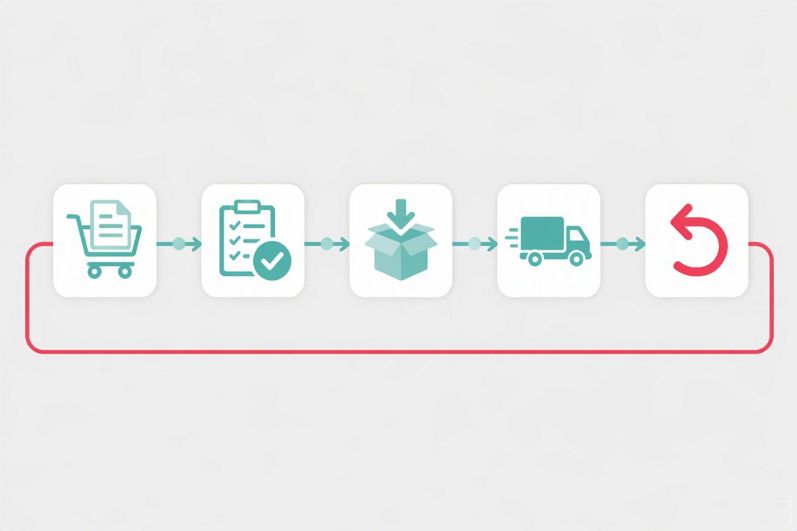
The simplest way to understand supply chain order management is to follow a single order through the business.
1. Order Capture
The order comes to your business via a website, the wholesale website, marketplace, EDI, phone call, or email.
Every order should be entered into one system without having to transfer data manually from one platform to another. With a health supplement distributor, an Amazon order and trade order should both be clearly visible in the system without needing different spreadsheets.
2. Validation and Allocation
Before fulfilment begins, the order needs to be validated. This can include checking payment, customer credit terms, delivery information and available stock.
The system then allocates stock from the appropriate warehouse or location. If the distributor has warehouses in Manchester and Bristol, for example, the available stock and fulfilment location need to be clear before the warehouse starts picking.
3. Fulfilment
The order then proceeds to the warehouse for picking, packing, and dispatch.
This process ensures that the warehouse has the required information to ship the order without having to wait for any email or look into any other system. The status of the order can then be updated within the company.
4. Delivery and Tracking
Delivery details become part of the process of the life cycle of the order once it has been collected by the carrier.
Teams can spot delayed deliveries before customers call to report an issue.
Learn more: What is distributed order management?
5. Returns and Reverse Logistics
The process continues if the customer returns the product.
If a customer returns an item, the business needs to record the return, update inventory, process the refund and understand the reason behind it. That information can also reveal recurring product, fulfilment or quality problems.
Why Supply Chain Order Management Matters for Small Businesses
When there’s an increasing order volume, order management plays an important role in minimising the discrepancies between the orders placed, inventory availability, and deliverables.
Fewer stockouts and oversells
Suppose a distributor has 20 units of a product available and receives 15 orders through its website. If another five customers order through Amazon before inventory is updated, the business could accidentally sell more stock than it has.
Connecting orders with real-time inventory sync helps prevent this situation and gives teams a clearer view of available stock.
Order entry made faster
Manual order entry creates work each time someone types an order in from one system to another. In light of receiving hundreds of orders each week, the minutes begin to add up.
Automated order capture and fulfilment workflows help reduce time spent re-entering data and increase time spent on exceptions.
Better supply chain visibility
The Sales Manager should not have to ask for an inventory status from the warehouse, and the Purchasing Manager independently finds out when the next delivery will be made by the supplier.
Data connectivity provides all these departments with a common picture of orders and inventory.
Better customer experience
Accurate stock information makes it easier to provide realistic delivery dates. When something goes wrong, teams can identify the problem and act rather than waiting for the customer to complain.
Easier scaling
A process that works for 50 orders a week can quickly become unmanageable at 500.
Systematising order management allows growing businesses to handle additional orders, channels and locations without increasing manual administration.
Purchase Orders and the Upstream Side of Supply Chain Order Management
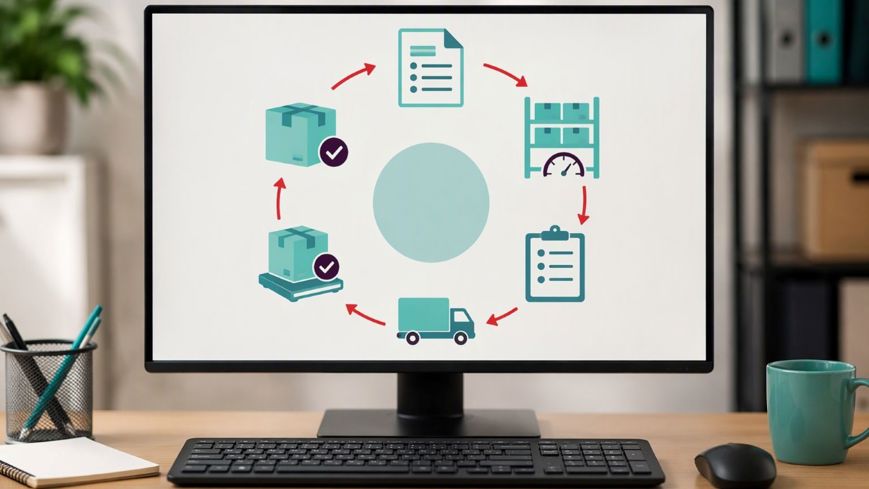
Order management is not always downstream moving from the customer to the warehouse. Order management is upstream, as well, in manufacturing and distribution companies where a customer order will be followed by some activity related to the supplier.
Take a health supplement distributor receiving an order of 500 units while having only 200 units available. This triggers a purchase order to the supplier.
This sequence could include:
- Customer order
- Stock position
- Purchase order
- Supplier delivery
- Goods receipt
- Customer order fulfilment
Lead time directly affects when you can fulfil the order. For example, if the supplier claims that the other 300 items are due to be delivered on 12th October, this data could affect the forecasted date of shipment.
Three-way matching is also an important part of upstream order management. This involves reconciling the purchase order, the goods receipt, and the supplier invoice to confirm that what was ordered, received, and billed all align, helping to prevent billing errors and overpayments before they reach the accounts team.
The same goes for the manufacturing business. In a situation where a customer places an order, there is a need for purchasing the raw material or components before production starts.
Unleashed links purchase orders, inventory, and sales orders.
Common Supply Chain Order Management Challenges
1. Disconnected systems
In cases where the sales orders are in one system while the inventory and accounts are managed by other systems, there is the problem of manual transfer of the data from one system to another, hence leading to wrong stock figures and duplication of data.
Solution: Connecting sales orders, inventory, procurement and accounts. For example, Unleashed is a platform where all the sales orders, inventory, and purchases can be brought together.
2. Inventory visibility gaps
Without accurate inventory data, a business can promise products that are no longer available or carry excess stock that is tying up cash. The problem becomes more complicated when the same SKU is sold through several channels or stored across multiple warehouses.
Solution: Use real-time, SKU-level inventory tracking across locations and sales channels. Set reorder points so the team knows when stock needs replenishing rather than discovering a shortage after an order has already been placed.
3. Manual bottlenecks
Using spreadsheets, e-mail chains and manual order entry may be effective as long as there are fewer orders to handle; however, as the organisation grows bigger, these processes can become a bottleneck in the process. In case the one person in charge of handling orders is unavailable, the whole process will get delayed.
Solution: Automation of order capturing, stock updating and purchase order generation. This will enable the team to deal with exceptions only.
4. Poor demand forecasting
When order history is disconnected from inventory planning, businesses tend to react to demand instead of anticipating it. A seasonal spike can result in stockouts, while an inaccurate forecast can leave the warehouse full of slow-moving products.
Solution: Combine historical sales data, current inventory and supplier lead times when planning purchases. Demand forecasting tools can help identify upcoming requirements and give purchasing teams more time to act.
5. Returns complexity
Returns can introduce an additional administrative process following the completion of the sale. Slow recording of the returns will lead to incorrect inventory numbers, and delays in issuing refunds can increase the volume of customer service administration.
Solution: Integrate the return process into the order process. The returned goods should be recorded, inventory numbers updated, and either refunded or credited together with the reason for return.
6. Lack of exception visibility
A supplier might miss a delivery date, a warehouse might run short of stock or a carrier might delay an important shipment. If your team only discovers the problem when the customer gets in touch, there is little time to fix it.
Solution: Set up alerts for low stock, supplier delays, failed deliveries and other exceptions. Giving the team visibility while there is still time to intervene turns order management from a reactive process into a proactive one.
Best Practices for Supply Chain Order Management
Each of the following best practices will give you an idea for a specific action you can implement today to see the results you want:
1. Centralise order capture
Bring website, marketplace, wholesale and other orders into one system wherever possible. This removes unnecessary manual re-entry and gives the team one place to check order status.
2. Connect orders to real-time inventory
When a customer places an order, available stock should update accordingly. This is particularly important for businesses selling the same SKU through multiple channels.
3. Automate reorder points
Set reorder points based on demand and supplier lead times. When stock falls below the threshold, the business can act before the product becomes unavailable.
4. Use demand forecasting
Historical sales data can reveal seasonal demand, fast-moving products and changing purchasing patterns. Combining sales history with current inventory makes purchasing decisions more deliberate.
- Learn more: Constrained vs Unconstrained Demand Forecasting
5. Set up exception alerts
Flag low stock, delayed supplier deliveries and fulfilment problems before they reach the customer. The goal is to give the team time to fix the issue.
6. Track the right metrics
At minimum, monitor order fill rate, order accuracy, on-time delivery and order cycle time. These metrics show where orders are getting stuck and whether improvements are actually working.
Key Metrics for Supply Chain Order Management
| Metric | What it measures | Why it matters |
|---|---|---|
| Order fill rate | Orders fulfilled completely from available stock | Shows how effectively the business meets demand |
| Order accuracy rate | Orders picked, packed and shipped without errors | Highlights fulfilment problems and their potential effect on returns |
| On-time delivery rate | Orders delivered within the promised timeframe | Shows delivery and carrier performance |
| Order cycle time | Time from order placement to delivery | Reveals how efficiently orders move through the process |
| Inventory turnover | How often stock is sold and replaced | Helps assess whether inventory levels match demand |
| Return rate | Percentage of orders returned | Can reveal product, fulfilment or description problems |
These metrics are only useful if the underlying data is accurate. If inventory and orders live in separate spreadsheets, calculating real-time KPIs becomes much harder.
How to Choose Supply Chain Order Management Software
Before choosing order management software that fits your supply chain needs, ask:
- Can it manage purchase and sales orders?
Your system should connect what you buy with what you sell.
- Does inventory update in real time?
Stock availability needs to reflect actual orders across locations and channels.
- Which sales channels can it connect?
Check your website, marketplaces, B2B portals and other order sources.
- Does it integrate with your existing systems?
Look for connections to platforms such as Shopify, WooCommerce, Xero and QuickBooks.
- How quickly can you implement it?
A growing business may not have the resources for a lengthy enterprise implementation.
- What support is available?
Look at onboarding, training and ongoing support before committing.
- Will it scale?
Check whether it can support additional SKUs, warehouses, users and sales channels as the business grows.
Tools for Managing Orders in the Supply Chain

Depending on your type of company, you may need an order management system, an inventory solution, a warehouse management system, an ERP system, or a combination of all of them.
What matters is that these systems share data in real time. If the OMS says that the product is in stock, but the inventory management system tells that it’s out, then the problem is that these systems aren’t synced.
Order Management System (OMS)
An order management system acts as the central hub for customer orders. It can collect orders from different channels, apply fulfilment rules, allocate inventory and track each order through to delivery.
For small businesses, a full enterprise OMS may have more functionality than necessary. Platforms such as Unleashed combine order management with inventory, purchasing and production, which can make more sense when those processes are tightly connected.
Inventory Management System (IMS)
An inventory management system keeps track of what stock the business has, where it’s stored and how quickly it’s moving. It can support functions such as stock counts, SKU-level tracking, reorder points, batch tracking and inventory forecasting.
This is particularly important during order allocation. If a distributor has 50 units of a product across two warehouses, the order management process needs to know where those units are before deciding how to fulfil an order.
Warehouse Management System (WMS)
A warehouse management system lets you handle everything that happens physically inside the warehouse. That can include receiving stock, putaway, picking, packing, transfers and order dispatch.
Mintsoft is a platform with warehouse, order and fulfilment capabilities that’s well-suited to ecommerce and 3PL operations where multiple customer orders need to move through the warehouse quickly.
For mobile, Unleashed provides a warehouse management app for tracking every warehouse operation.
Enterprise Resource Planning (ERP)
An ERP links several business processes into one system, usually consisting of finance, purchasing, inventory, sales and manufacturing. Systems like SAP and Oracle are built for larger organisations that have more intricate processes and information needs.
However, for a small but growing company with 20 employees, an ERP can add unnecessary layers of complexity to a system. A dedicated platform will help with inventory, purchase and ordering functionalities needed by the business without having to change all its processes.
How Unleashed Supports Supply Chain Order Management
Accurate order management in small and mid-sized businesses is dependent on the accuracy of inventory information.
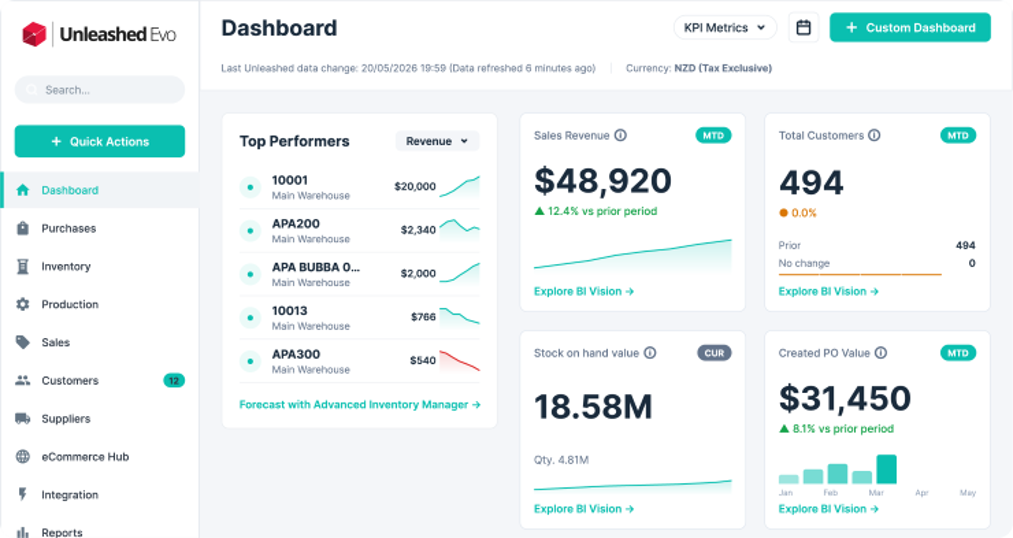
Unleashed connects inventory management, sales orders, purchasing and production, providing all concerned parties with an integrated view of what has been ordered, what is in stock, and what needs to be ordered.
Some features include:
- Inventory management and tracking for multiple warehouses and locations
- Order management for different channels
- Automated reordering point and purchase order generation
- Forecasting with the help of Advanced Inventory Manager
- Tracing from purchase order to customer delivery
- Integration with various platforms, including Shopify, WooCommerce, Amazon, Xero, and QuickBooks
- Integration with ecommerce, 3PL, and logistics platforms
Sign up for a 14-day free trial to see it in action and get more clarity and structure for your own order management process.
Frequently Asked Questions
What is order management in supply chain?
Supply chain order management is the process by which customer orders are received, validated, allocated, fulfilled, and tracked from purchase through delivery and return. Supply chain order management links sales orders to inventory, purchasing, warehousing, and logistics. Unleashed allows product companies to link these processes using one platform.
What is the difference between order management and supply chain management?
Supply chain management refers to the broader movement of products, from sourcing and procurement to production, inventory, and logistics. Order management refers to customer order handling. Order management and supply chain management are interlinked as a customer order may have an impact on inventory, procurement, and production activities.
What are the 5 C's of supply chain management?
The five C's of supply chain management are Connect, Create, Customise, Coordinate, and Collaborate. This framework describes how effective supply chains link partners and data (Connect), develop products and processes (Create), tailor offerings to customer needs (Customise), align activities across the chain (Coordinate), and work together toward shared goals (Collaborate).
What are the most important KPIs for supply chain order management?
Core KPIs include order fill rate, order accuracy rate, on-time delivery rate, and order cycle time. Inventory turnover and return rate can also help gain insights into how efficient the inventory is and how well orders are fulfilled. Consistent tracking of these metrics is only possible through having reliable data on orders and inventory.
What is the biggest challenge in supply chain order management?
Disjointed systems is one of the most common challenges for growing product companies. Having sales, inventory, purchases, and fulfilment managed in silos means there is a risk of overselling and other mistakes. Bringing these operations together within a single system such as Unleashed will ensure consistency of orders and inventory.
What tools are used for supply chain order management?
The typical tools used for supply chain order management are OMS, inventory management software, WMS, and ERP systems. The latter usually cover different aspects of order management, although some solutions are capable of combining several of these features. Unleashed integrates inventory, sales orders, purchases, and production for product businesses.


