

How to Improve Demand Forecast Accuracy
Let’s start with the end in mind. You can never forecast demand 100% accurately. If that were true, nobody would have an over- or understocking issue. The goal behind improving your forecasts is to get as close to reality as possible.
Accurate forecasts depend on data accuracy and how well you’re able to gauge economic conditions, customer sentiment, the competitive landscape, and other external factors over the forecast period.
In this guide, we explain various methods to improve demand forecast accuracy and walk you through the top demand planning solutions available in the market.

Table of contents
- What is demand forecasting?
- Top 7 ways to improve demand forecast accuracy
- Why is demand forecast accuracy important?
- How to approach demand forecasting and ensure its accuracy
- What are the most common reasons demand forecasts are inaccurate?
- How do you know if your demand forecast is accurate?
- The demand forecast accuracy formula and how to use it
- What is an acceptable forecast accuracy in demand planning?
- Top 5 demand planner software for accurate demand forecasting calculation
- How machine learning and AI can improve demand forecast accuracy
What is demand forecasting?
Demand forecasting is the process of estimating future demand based on past sales data and expected future scenarios.
For example, if in the past you’ve seen year-on-year demand increase by ~10% per year and you sold 10,000 units last year, 11,000 units is a good starting point for your demand forecast.
Then factor in other variables. If you expect an economic slowdown over the next year, you might sell fewer than 11,000 units. On the other hand, if the demand for your product is accelerating because of innovation, you might sell more.
Top 7 ways to improve demand forecast accuracy
Here are seven of the best ways to improve forecast accuracy:
Use clean data
The best way to improve forecasts is to feed reliable data. It’s basically garbage in, garbage out.
For example, your sales data might show 1,000 units sold last month. However, if 200 of those were returned but mistakenly recorded as new sales, your forecast will overestimate demand.
If you don’t clean that data, your model will assume demand is rising and project higher sales. This may lead you to overstock. So always scrub your data for duplicates, outdated entries, and errors before you feed it to your model.
Consider external factors
Consider external demand drivers when building your forecast. Take a look at prevailing market trends, economic shifts, innovative or disruptive products, and other factors that can impact your product’s demand.
Segment products
Not every SKU flies off the shelf at the same velocity. If you sell multiple products, you need to take that extra effort and project demand for each SKU separately because demand for each product may behave differently.
You don’t necessarily have to project demand for each individual SKU if you can group them into segments. See if you can break SKUs into logical segments, like lifecycle stage or sales velocity.
Apply segment-specific forecasting methods to each segment, and you’ll get a more accurate forecast than if you forecast for your entire product line together.
Involve all teams
Your friends in sales interact with customers firsthand. They’re in a better position to assess customers’ sentiments. Similarly, the marketing team closely tracks what competitors are doing.
Involve these teams when building your forecasts. They can help you ground your assumptions in reality and make your forecasts more accurate.
Plan for multiple scenarios
It’s nearly impossible to be 100% accurate with your demand forecasts. So, start with your most likely forecast, and plan for uncertainty by also preparing for the best- and worst-case scenarios. Even the best-case scenario requires planning—if demand significantly exceeds your forecast, you could run out of stock.
Shorten forecast horizon
The further out you look, the fuzzier the crystal ball. Demand signals change rather quickly, so keep forecasts on a shorter time horizon if you want more accuracy. Update them frequently (called rolling forecasts) to stay closer to reality and make adjustments as demand variables change.
Invest in technology
Spreadsheets are a terrible way to manage data or build forecasts, especially since there are AI-powered tools that can pretty much complete a large part of the process independently.
AI-powered tools can process large datasets, detect patterns, clean inconsistencies, and continuously improve through machine learning. By adopting these technologies, you gain access to higher-quality insights and more robust forecasting models, freeing up time to focus on strategy.
Why is demand forecast accuracy important?
An accurate demand forecast impacts multiple aspects of your financial position. Without a reliable forecast, you end up overstocking or understocking inventory. Both have implications.
If you overstock, you tie up a lot of cash in inventory. That leaves you with lower working capital and, depending on product type, a greater risk of obsolescence.
Understocking exposes you to stockout risks and can damage your reputation. Customers might walk away just because you don’t have a specific product in inventory when they were looking to buy.
What are the benefits of accurate demand forecasting?
Accurate demand forecasting has multiple benefits:
- Lowers risk of over- and understocking: You’re less likely to significantly over- or understock when you have a reliable demand forecast. Your forecasts can’t be 100% accurate, but they’re still the best way to lower the risks of holding too much inventory and stockouts.
- Frees up working capital and cash: When you don’t overstock, you have more working capital and cash on hand. This helps minimise accounts payable balances or pay off other current liabilities. You can also invest cash in money market securities to earn extra interest income.
- Protects your reputation: You’re less likely to run out of stock when you forecast demand accurately. This means you won’t have to turn customers away, who may just as well buy from a competitor and avoid coming to you again altogether.
- Helps avoid paying extra for urgency: If you run out of stock, you’ll want to restock faster. Depending on your terms with the supplier, they may charge extra for an urgent delivery. This changes your cost structure and shrinks your gross margins.
What are the risks of inaccurate demand forecasting?
Inaccurate demand forecasting damages more than your topline figure. Here are the risks of inaccurate demand forecasting:
- Reputation: This is the biggest risk of inaccurate demand forecasts. When a customer can’t find an item on your website or in your store, they’re quite likely to just look for it elsewhere. The customer leaves your store or website with a poor experience and then goes to a competitor. The result? You lose reputation that’s hard to earn back, and that’s why this is your biggest risk.
- Increased costs and lower profitability: When you run out of stock, you might need to pay extra for expedited delivery from your supplier. This translates to a lower gross margin. Holding excess stock isn’t a great strategy either because there’s an opportunity cost to holding inventory. In either case, you end up paying extra and shrinking your margins.
- Inefficient resource allocation: Two main resources you can go wrong with are capital and staffing. An inaccurate forecast might lead you to allocate a ton of capital when there’s not enough demand. It can also lead you to hire too many or too few seasonal workers, to, say, handle Black Friday traffic.
How to approach demand forecasting and ensure its accuracy
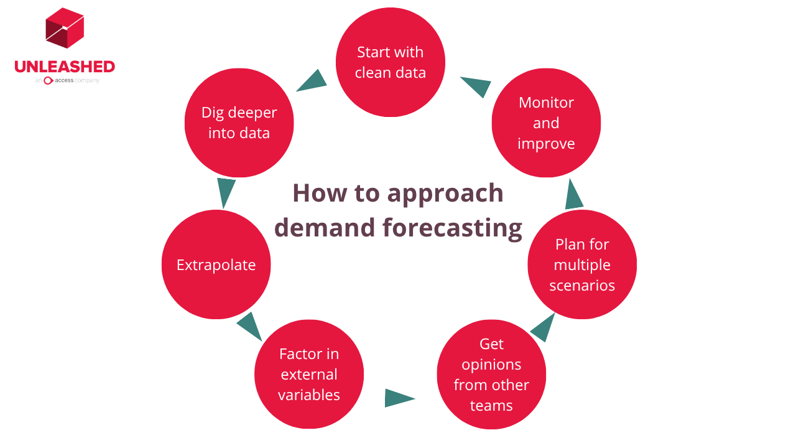
There’s no foolproof method to ensuring complete accuracy, but here’s an approach that will help you achieve reasonable accuracy:
- Start with clean, reliable data: Data is food for your forecasts. If data is inaccurate, inconsistent, or unreliable, your forecasts will be the same way. Make sure you have systems in place to collect clean and reliable data and use it to extrapolate demand over the forecast period.
- Dig deeper into data: All SKUs may not behave the same way. Fast-moving items and seasonal ones need to be forecasted differently. If data is available, forecast demand for each SKU (or SKU category) for a more granular estimate.
- Extrapolate: You don’t necessarily have to go with a linear forecast. You can also use AI or ML-based predictive analytics tools if available. They can handle more complex datasets and offer more accurate forecasts.
- Factor in external variables: Look at the macroeconomic environment, competitors’ strategies, weather, and even social media trends if relevant. Factor the effect of those into your forecast. While there may be 100s of variables, you must focus on the most impactful ones to optimise time and effort.
- Get opinions from other teams: Ask your friends in sales, marketing, supply chain, and other departments about the demand outlook based on what they notice during interactions with customers and clients. Factor in their opinions into your forecast.
- Plan for multiple scenarios: By this time, you should have a demand estimate. But external factors can always change. Plan for multiple scenarios to understand how demand will look if the most impactful variables turn unfavourable or favourable. This helps you prepare for any eventuality.
- Monitor and improve: Forecasts should be dynamic. As conditions shift, regularly update your projections to reflect new variables and realities.
What are the most common reasons demand forecasts are inaccurate?
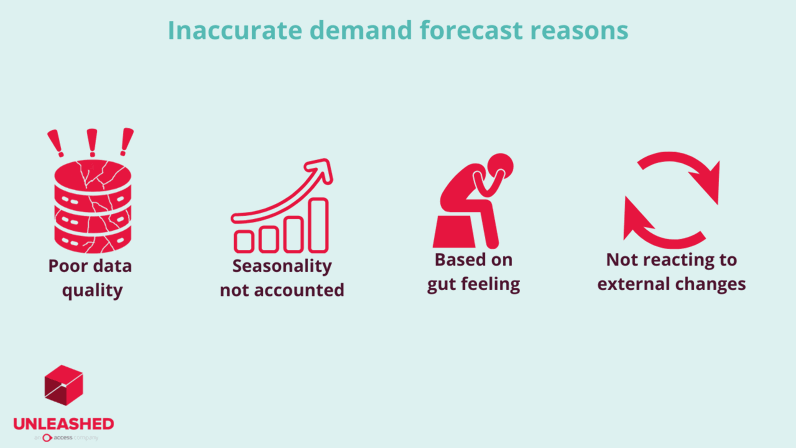
Demand forecasts are usually inaccurate when they're:
- Built with poor-quality data
- Don’t account for seasonality, trends, and external factors
- Based on gut feeling
- Updated as external factors change
How do you know if your demand forecast is accurate?
There are various metrics and “sanity checks” you can use to assess the accuracy of forecasts:
- Forecast accuracy (FA%)
- Mean absolute percentage error (MAPE)
- Bias
- Tracking signal
- Service levels and stockouts
Forecast accuracy (FA%)
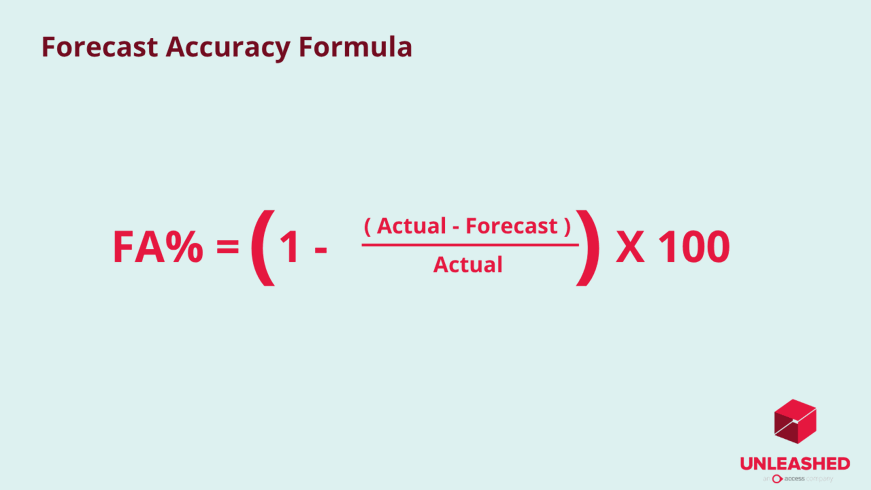
Forecast accuracy is the simplest forecast accuracy measure. It measures how close your forecasted demand was to actual demand. Here’s the formula:
Mean absolute percentage error (MAPE)
MAPE shows the average percentage error across forecasts. A lower MAPE indicates greater accuracy. Here’s the formula:
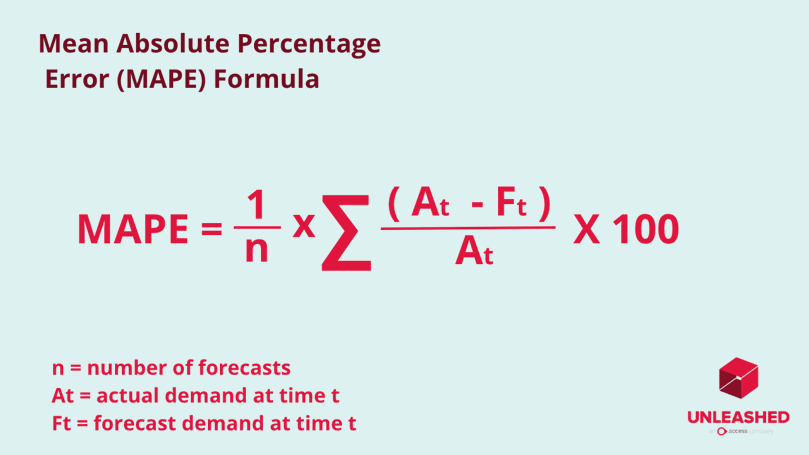
Where:
n = number of forecasts
At = actual demand at time t
Ft = forecast demand at time t
Bias
You may have a biased view of the economy, competitive landscape, or other external factors. These can creep into your forecasts and skew them.
Tracking signal
This shows whether forecast errors are random or if there’s a consistent pattern (like always being too optimistic). Tracking signal is a great way to see if there’s a consistent bias in your forecasts. If errors aren’t random, you need to fine-tune your forecasts and eliminate the issue. The forecast is considered “in control” as long as your tracking signal stays between -4 and +4. Here’s the formula for tracking signal:
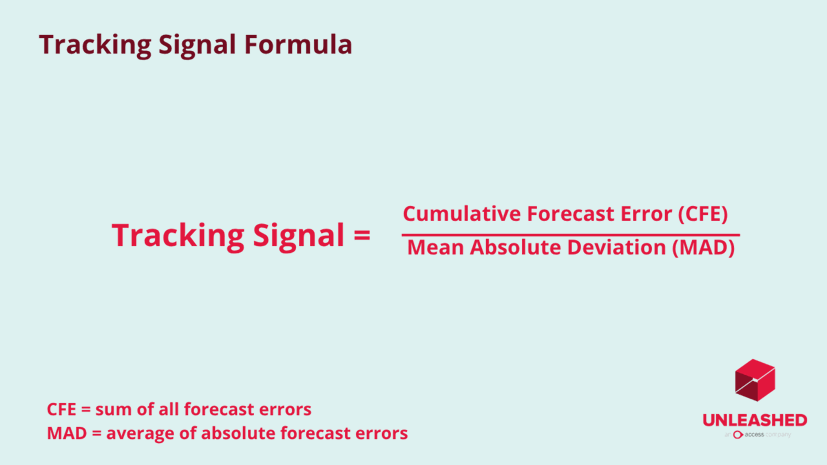
Where:
CFE = sum of all forecast erros (Actual - Forecast)
MAD = average of absolute forecast errors
Service levels and stockouts
If customers get what they want, when they want it, without you overstocking, that’s a sign that your forecasts are working.
How do I know if demand forecast inaccuracies derive from my data, model, or assumptions?
You need to dig around a little to find the source of inaccuracies. Here’s where to look:
- Check your data: See if your data has missing values, duplicates, or outliers (like a one-off bulk order). If you notice that errors vary wildly from period to period, this is usually the cause.
- Test the model: Compare results across multiple forecasting models. If you’re using moving averages, use exponential smoothing or a machine learning algorithm. See which one performs the best and use that one. Often, overly complex models “overfit” past data and fail in the real world.
- Check your assumptions: Assumptions are like forecasts. They’re almost never 100% correct. But some can be significantly off. See if there’s a marketing campaign you thought would double your sales but didn’t, or if you underestimated the impact of a competitor’s new product.
- Look for bias: If there’s bias in your forecast, it’s a model or assumption issue, which means the bias either comes from you or your model. If errors are random, you may have a data quality problem or an insufficiently sophisticated model.
Limitations in demand forecasting
When building your forecasts, here are some limitations you should keep in mind:
- Time and cost: Building an accurate and reliable forecast requires time, research, skilled analysts, data, and specialized tools. None of these is cheap. But having the right tools in your stack can automate a large portion of this process, reducing the time required and costs.
- Product lifecycle: Forecasting demand for products at the beginning or end of their lifecycle is trickier. There’s no historical data for new launches, and predicting the decline for mature products is usually difficult. Even the best models might stumble while dealing with such products.
- Data availability and quality: Missing, inaccurate, or inconsistent data skews your forecast. You need to proactively build a clean database to improve forecasting accuracy over time.
- Breakdown in communication: Marketing, sales, and operations need to be aligned. If there’s miscommunication between these teams, even accurate forecasts are likely to fail in execution.
The demand forecast accuracy formula and how to use it
Here’s the forecast accuracy formula:
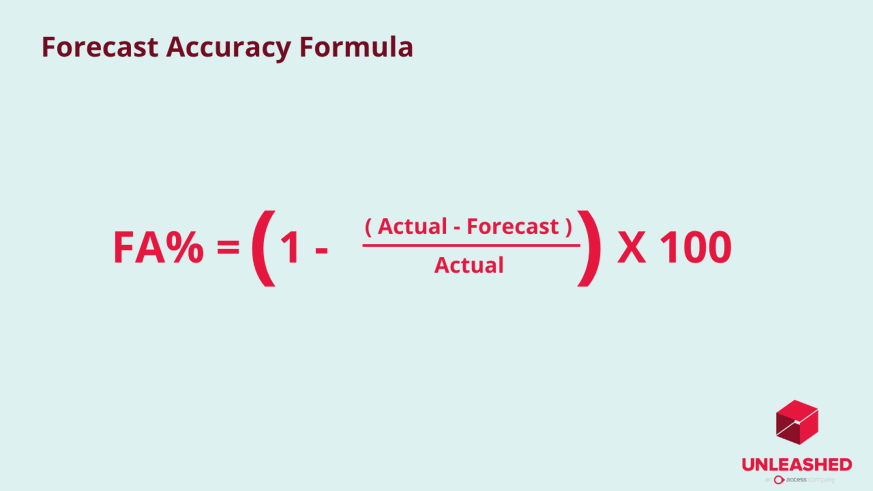
FA% = ( 1 - (Actual - Forecast) / Actual)) x 100
Where:
- Actual = what really happened (demand/sales)
- Forecast = what you predicted
If your actual demand was 11,000 units and the forecasted demand was 10,000 units, your forecast accuracy is 90.91%:
90.91% = ( 1 - (11,000 - 10,000) / 11,000) x 100
What is an acceptable forecast accuracy in demand planning?
There’s no blanket “acceptable” forecast accuracy. It depends on your industry, product mix, and planning horizon.
For example, a 70–80% forecasting accuracy is considered decent for a retail business that sells fast-moving items. If you’re a manufacturer with stable demand and fewer SKUs, 80–90% is more realistic, especially for high-volume repeat items.
Top 5 demand planner software for accurate demand forecasting calculation
If you’re looking for a system that can help you build demand forecasts, here are five of the best systems on the market that can help.
1. Unleashed
Unleashed is a cloud-based inventory management system. It’s the best software for small- or medium-sized businesses. It provides real-time visibility and control over inventory and an Advanced Inventory Manager (AIM) module that helps set optimal reorder levels and model future demand (seasonal, manual, or linear).
Best for: Small to mid-sized product businesses, including manufacturers, wholesalers, and multichannel retailers.
Key features:
- Real-time inventory and tracking
- Advanced Inventory Manager (AIM) module for demand forecasting
- Multichannel order and stock management
- Warehouse and order management features
- Production and BOM management
2. o9 Solutions
o9 Solutions offers AI-powered demand planning. It’s designed for large enterprises looking to improve forecast accuracy.
Best for: Large enterprises and global brands running ops across multiple regions and complex multi-tier supply chains.
Key features:
- Advanced ML-based demand forecasts
- Demand Sensing feature provides short-term forecasts based on leading indicators
- New Product Integration (NPI) forecasting supports forecasting for new products, accounting for lifecycle stages, cannibalisation effects, and ramp-up/down curves
3. Anaplan
Anaplan is a cloud-based platform that offers AI-powered demand planning solutions. It integrates data from various sources and runs that data through advanced analytics to help you build more reliable forecasts.
Best for: Mid-to-large companies that need integrated, driver-based planning across finance, demand planning, and commercial ops.
Key features:
- AI-driven forecasting uses machine learning and statistical methods to generate precise forecasts
- Scenario planning helps build various demand scenarios and assess their impact
- Customizable dashboards provide insights into demand trends, forecast accuracy, and other KPIs
4. Cube
Cube is a no-code FP&A platform that helps finance teams build real-time, driver-based forecasts and model scenarios.
Best for: Finance-led SMBs and scaleups (from small startups to mid-market) that are spreadsheet-centric and need to professionalise FP&A and drive-based forecasting without heavy IT work.
Key features:
- Real-time forecasts based on business drivers like sales volume, pricing, etc.
- Unlimited scenarios and what-if analysis
- AI-powered smart forecasts that convert historical financial or other business data into forecast projections automatically
5. ICRON Demand Planning Solution
ICRON Demand Planning is an AI/ML-powered demand forecasting tool within a customer-centric supply chain platform.
Best for: Mid-market to large retail, distribution, or manufacturing companies that prioritise customer-centric supply chain planning and SKU-by-location forecasting.
Key features:
- Advanced demand management that combines baseline forecasts with inputs from sales teams and consolidates multiple data sources
- Outlier detection feature that identifies outliers in historical sales
- Can segment demand forecasts by product/customer combinations, allowing you to forecast at multiple levels (such as location, SKU, etc.)
How machine learning and AI can improve demand forecast accuracy
Traditional forecasting leans on historical data and a bit of educated guesswork. That’s a terrible approach for modern businesses. You need AI and ML because, in addition to crunching large datasets, they also learn and adapt based on new data. This allows them to predict a lot more accurately.
Let’s take a closer look at how AI improves demand forecast accuracy:
- Data integration and processing: AI tools can pull data from all sources, process large datasets, and make sense of it faster than any legacy tool ever could. This gives you cleaner and richer data that helps you build more accurate forecasts.
- Pattern recognition: ML algorithms can spot trends and correlations. For example, if you’re a cosmetics brand, you could feed the model sales data of sunscreen sales, and it will identify spikes, sudden drops, or any other anomalies in the data that humans might miss.
- Continuous learning and adaptation: AI-based forecasts aren’t static. They evolve as new data flows in. The underlying ML algorithm re-trains itself to adjust for changing customer behaviour, seasonality, market shocks, or other relevant factors, keeping your forecasts sharp and current.
- Automation: AI automates almost all of the grunt work in your forecasting process. This translates to fewer manual errors, faster updates, and more time for teams to focus on strategy.
- Improved responsiveness: AI helps you respond better when demand moves suddenly. For example, a viral post could drive sales higher, or a supply disruption could increase stockout risk without prior notice. In such cases, AI can quickly recalculate demand forecasts and suggest a course of action, which could be reallocating inventory between warehouses, revising procurement orders, or tweaking pricing or promotions to smooth out demand fluctuations.

Try Unleashed 14 days for free
If you’re working on your demand forecast for the next quarter or year, and need advanced analytics and automation to simplify the process and make forecasts more accurate, try Unleashed for free today.
Frequently Asked Questions
How accurate is demand forecasting?
Demand forecasting accuracy varies by industry and product type, but most businesses tend to aim for 70–85% accuracy. Forecast accuracy is typically higher for products with stable demand, while lower for seasonal or new products.
Which method makes demand forecasts more accurate?
Forecasts are most accurate when you combine historical data with advanced models while factoring in external variables such as seasonality and market trends.
What are the effects of inaccurate demand forecasting?
Inaccurate forecasts can lead to overstocking, stockouts, higher costs, poor cash flow, supply chain inefficiencies, and reduced customer satisfaction.
What is the best forecast accuracy method?
MAPE is considered the most reliable method for evaluating forecast accuracy, but you can also use forecast accuracy % if you don’t want to complicate things.
What are the criteria of good demand forecasting?
Good demand forecasts are accurate, timely, cost-effective, flexible, based on reliable data, and regularly updated to reflect changing market conditions.
How to check forecasting accuracy?
You can check forecast accuracy by comparing actual demand against forecasted demand using metrics like forecasting accuracy %, MAPE, and tracking signal.