
How to Calculate Ending Inventory – The Complete Guide
Calculating ending inventory at the end of a financial year can be a challenge. It's a time when you're likely juggling between creating inventory reports and fulfilling end of year sales. This article simplifies those ending inventory challenges by looking at:

Table of contents
- What is the ending inventory formula?
- How do you calculate ending inventory? An example
- Is there a faster way to calculate ending inventory?
- Why is it important to calculate ending inventory?
- Who should calculate ending inventory?
- Beginning inventory
- Ending work in progress (WIP) inventory
- Your inventory valuation method will impact ending inventory
- How Unleashed can help
- Frequently asked questions
What is the ending inventory formula?
Ending Inventory is the value of the sellable inventory stock or product that remains at the end of a financial year. To calculate ending inventory you start by adding the beginning inventory and net purchases, then subtracting the cost of goods sold (COGS). So, the ending inventory formula is:
Ending Inventory = Beginning Inventory + Net Purchases – COGS
How do you calculate ending inventory? An example

Imagine you are a stock manager for Jammin It Out, a company that makes jam. As the end of financial year approaches, you need to create an inventory report to understand the value of the assets you hold. You access balance sheets to calculate ending inventory:
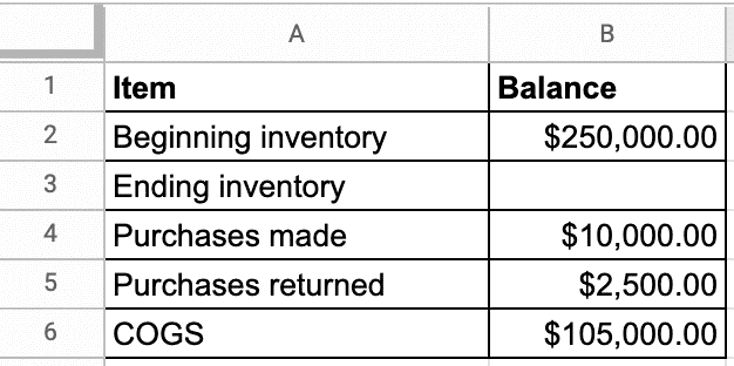
To calculate ending inventory, you use the formula: Ending inventory = Beginning Inventory + Net Purchases – COGS Ending inventory = $250,000.00 + ($10,000.00 - $2,500.00) – $105,000.00 Ending inventory = $152,500.00 You now know that you are ending this year with $152,500.00 worth of inventory. In other words, you will start the next financial year with $152,500.00 worth of sugar, jars, finished jam, and so on.
How to calculate ending inventory without cost of goods sold
If you don’t have the cost of goods sold (COGS) figure available, you can use the gross profit method to estimate ending inventory.
Here’s how:
- Estimate gross profit using historical data or industry benchmarks.
- Calculate COGS = Net Sales × (1 – Gross Profit Margin).
- Then apply the standard formula: Ending Inventory = Beginning Inventory + Purchases – Estimated COGS.
This method is useful for interim reporting but should be verified with a physical inventory count for accuracy.
Is there a faster way to calculate ending inventory?
In short, yes. Integrating your accounting and inventory management software means that your apps will do the heavy lifting for you. All you have to do is maintain accurate stock information so that any information that flows through to your accounting software is correct. Using the right software can help you accurately determine the value of your ending inventory much more quickly and with less stress.
Why is it important to calculate ending inventory?
It is important to calculate ending inventory because product businesses need to maintain accurate balance sheets and create consistent reports. Overstating or understating ending inventory will impact COGS, gross margin and net income on the balance sheet. An incorrect inventory valuation causes two income statements to be wrong because the ending inventory carries over to the next financial year as the beginning inventory. Recording an accurate measure of inventory value will prevent discrepancies in future reports.
To accurately calculate ending inventory, you should also conduct a physical count of the remaining inventory stock on hand. A physical inventory stock count allows you to uncover any discrepancies between the actual stock and what you have in your inventory management system. For example, your system might show you have 1000 jam jars left in stock but due to breakages, you're actually only left with 950 jars. If you didn't conduct a stocktake, you'd be creating reports and balance sheets with incorrect data.
Who should calculate ending inventory?
An accountant or the person responsible for your company's financial records should be calculating ending inventory. This process requires the accuracy of all data inputs at many levels of the business — from physical inventory stock counts to accurate sales and purchase data. Regardless of who actually calculates this figure, all managers and business owners should also have a basic understanding of these figures to help assess what future actions your business should take.

Beginning inventory
Beginning inventory and ending inventory are closely linked but serve different purposes.
Beginning inventory refers to the value of stock at the start of a financial period, while ending inventory is the value of stock remaining at the end of that period.
Understanding both beginning inventory and ending inventory is crucial for accurate financial reporting and inventory management.
So, the beginning inventory formula is:
Beginning Inventory = COGS + Ending Inventory - Net Purchases
Why is it important to know beginning inventory?
The beginning inventory figure represents all the inventory stock a business can put towards generating revenue. Businesses can use the beginning inventory formula to understand the value of their inventory at the start of a new financial year. You can track changes to any beginning inventory by comparing this with the previous period.
Any changes usually signal a shift in the business, for example, decreasing beginning inventory could be a result of an increase in sales during the period, or it could be down to a supply chain or inventory management process issue. Increased beginning inventory could also be due to a business increasing stock before a busy holiday season – or it could signal a downward trend in sales.
Ending work in progress (WIP) inventory
Work in process (WIP) is inventory that's partially completed but needs more processing before it is finished. On a company's balance sheet, it is also listed as a current asset. To calculate ending WIP inventory, you need to use the formula:
Ending WIP Inventory = Beginning WIP inventory + Manufacturing Costs – Cost of Goods Manufactured
This formula only gives an approximate ending WIP inventory because factors such as spoilage and incorrect record-keeping can cause discrepancies between the calculated final figure and the cost of actual WIP inventory on hand.
Why track ending WIP inventory?
Businesses need to know ending WIP inventory as part of the period-end closing process. It can also indicate how well the manufacturing process is going. Values that are too high can signal slowdowns in the manufacturing process. And since WIP inventory items are not finished goods, they cannot be sold. This represents capital tied up in stock and lost revenue opportunities.
Your inventory valuation method will impact ending inventory
There are three ways to determine the value of your inventory — FIFO, LIFO and weighted average cost.
- First-in, first-out (FIFO) is an inventory method where the oldest items are processed first.
- Last-in, first-out (LIFO) is an inventory method where the newest items are processed first.
The method chosen influences your cost of goods sold and it is important to stick to one method because it will impact everything from budgeting to reordering inventory. Here's how each method will change the value of your ending inventory.
If you're using FIFO to calculate ending inventory
Most businesses use the first-in first-out (FIFO) method of allocating costs to inventory, which assumes the inventory stock that you purchased first is sold first. With FIFO, your inventory stock is valued at the most current price and can better reflect ending inventory and actual marketplace costs. The method is not fool-proof, and the actual flow of inventory may not align to this first-in, first-out pattern. Business owners may choose FIFO in periods of high prices or inflation, as it produces a higher value of ending inventory than its counterpart method last-in, first-out (LIFO). Most companies, especially those stocking fresh goods — like a seafood distributor for example — will use FIFO.
- Example: A bakery buys flour at £1/kg in January and £1.20/kg in March. If it sells 100kg in April, FIFO assumes the January stock is sold first, valuing COGS at £100 and ending inventory at the newer £1.20/kg rate.
If you're using LIFO to calculate ending inventory
The LIFO method assumes that the last item of inventory stock purchased is the first one sold. A business will use LIFO on the basis that the cost of inventory naturally increases over time, where pricing inflation is the norm. Businesses like tobacco stores, liquor stores, and pharmacies typically use the LIFO method because the cost of their inventory typically rises over time. The effect of this method is that the cost of the most recently acquired inventory stock will be higher than the cost of inventory purchased earlier. So, the ending inventory balance will be valued at earlier costs, and most recent costs will appear in the COGS. Accountants may encourage businesses to use LIFO during times of decreasing prices.
- Example: A pharmacy buys medicine at £5/unit in February and £6/unit in April. If it sells 50 units in May, LIFO assumes the April stock is sold first, valuing COGS at £300 and ending inventory at the older £5/unit rate.
If you're using weighted average cost to calculate ending inventory
Another method business owners and managers use to account for inventory on the balance sheet is the average weighted method. To use this method, simply divide the cost of goods the business has available for sale by the number of units for sale. This calculation will give you the weighted-average cost per unit. Average weighted COGS is a simple way to value ending inventory, and best to use when all products sold are identical. Unleashed Software uses the average weighted cost method. Read more about weighted average cost
- Example: A retailer has 100 units purchased at £10 and 200 units at £12. The weighted average cost is (£1000 + £2400) / 300 = £11.33/unit. Ending inventory is valued using this average.
How Unleashed can help
Managing inventory doesn’t have to be complicated. With Unleashed, you can automate calculations, track stock in real time, and generate accurate reports without the manual hassle. Our inventory management software integrates seamlessly with your accounting tools, giving you complete visibility and control over your beginning and ending inventory.
Ready to simplify your inventory process? Start your 14-day free trial and see how Unleashed can help your business save time, reduce errors, and make smarter decisions.
Frequently asked questions
What is an example of ending inventory?
Ending inventory is the value of stock remaining at the end of a financial year.
Example:
A jam manufacturer calculates ending inventory as:
Ending Inventory = Beginning Inventory + Net Purchases – COGS
If Beginning Inventory = £250,000, Net Purchases = £7,500, and COGS = £105,000, then:
Ending Inventory = £250,000 + £7,500 – £105,000 = £152,500
This means the business ends the year with £152,500 worth of inventory (e.g., sugar, jars, finished jam)
How to calculate closing stock without cost of goods sold?
If you don’t have COGS, use the Gross Profit Method:
- Estimate gross profit using historical data or benchmarks.
- Calculate COGS = Net Sales × (1 – Gross Profit Margin).
- Apply the standard formula:
Ending Inventory = Beginning Inventory + Purchases – Estimated COGS
This is useful for interim reporting but should be verified with a physical count.
What is the formula for closing inventory?
The standard formula is:
Ending Inventory = Beginning Inventory + Net Purchases – COGS
This calculates the value of sellable stock remaining at the end of the financial period.
How do you calculate cost of sales and ending inventory?
- Cost of Sales (COGS) is typically calculated as:
COGS = Beginning Inventory + Purchases – Ending Inventory - Ending Inventory uses the formula:
Ending Inventory = Beginning Inventory + Net Purchases – COGS
Both figures rely on accurate inventory and purchase data.
