


Global manufacturing trends
Over the last few years, manufacturers have contended with inflation, labour shortages, geopolitical shock and rapid digitalisation.
92% of manufacturers see smart manufacturing as the main driver of competitiveness over the next three years, showing how prevalent technology-enabled operations have become.
Consumer-led demand: personalisation and sustainability
Globally, the industry is shifting to meet consumer-led demand, with production processes designed to meet the changing requirements of customers.
Consumers are increasingly expecting personalised products, faster delivery systems, and sustainable and transparent practices.
There's also an increased expectation that demand can be anticipated by the use of data analytics, artificial intelligence, and tracking of customer trends.
Smart technology
Factories that utilise ‘smart’ technologies are regarded as key to manufacturing competitiveness. Investing in cloud computing, 5G capability, AI and advanced data analysis will enable manufacturers to set themselves up for the future.
Supply chain and logistics challenges
ith ongoing geopolitical uncertainty, rising energy prices and inflation on important & exported goods continue to cause vulnerability in the global supply chain. Manufacturers are required to find reliable domestic and international suppliers to avoid supply chain disruptions.
According to the Council on Foreign Relations, “In 2021 and 2022, consumer demand recovered far more rapidly than supply, which was limited by labour shortages, supply-chain interruptions, and the Russian invasion of Ukraine. Between the third quarters of 2020 and 2022, median global inflation soared from 1.9% to 8.7%”
Labour shortages
An incredibly tight labour market has also proved challenging through the pandemic, and the industry will be looking to adopt more technology-driven production to overcome the lack of skilled workers. Part of this will be considering better use of flexible work structures, more attractive remuneration packages, and more innovative processes and systems.
Agentic AI & strategic automation
AI adoption is shifting from automating simple tasks to AI making autonomous decisions, such as reorder points based on real-time data. AI-powered operations will be a driving factor for productivity and quality, marking major steps towards fully self-optimising production environments.

Recent trends in manufacturing processes
The manufacturing industry was being transformed by Industry 4.0 even before the pandemic, with features such as the use of big data and automation creating more efficient systems and processes.
Industry 4.0 is shorthand for the idea that we are in the fourth industrial revolution, with the advancement of technologies blurring the difference between physical and digital products.
The adoption of Industry 4.0 technologies can be difficult and expensive, but in a world which is increasingly digital, it is imperative for manufacturers to adapt if they are to survive.
Here we give you examples of the technologies being adopted in Industry 4.0.
Trends in additive manufacturing (aka 3D printing)
3D printing is an area of manufacturing which has seen rapid uptake across a range of products. It’s used for a huge range of goods, including rocket parts, food, rubbish bins and buildings.
The technology is becoming popular for a multitude of reasons, including its minimal reliance on a supply chain. For small items such as cutlery, for example, a 3D printer can simply print the quantity required at any given time.
The technology is also being used in far more complex areas such as healthcare. For example, the technology is being explored to see if it can support organ transplants by creating 3D printed replica body parts using living cells.
The Ultimate Manufacturing Guide
Internet of Things (IoT) trends in manufacturing
The Internet of Things (IoT) has long been touted as a technology which will upend the way we live, work and play. The recent acceleration in our shift to digital systems has again put it in the spotlight.
Broadly speaking, IoT is a system in which systems ‘talk’ to each other, using the likes of sensors and cloud systems to gather and analyse data in order to deliver connected outcomes to the user.
In manufacturing, the technology can be used to create networked devices and machines, enabling them to collect manufacturing data which can then be used to refine and improve systems. It also allows for the manufacturing of products without staff necessarily needing to be present, which saves on labour costs and minimises the risk of human error.
The IoT in manufacturing market is forecast to grow to $637.96 billion, from $141.18 billion, by 2032. This growth is driven by widespread adoption of smart sensors, connected machines and real-time analytics across factories.
The rise of automation and robotics in manufacturing
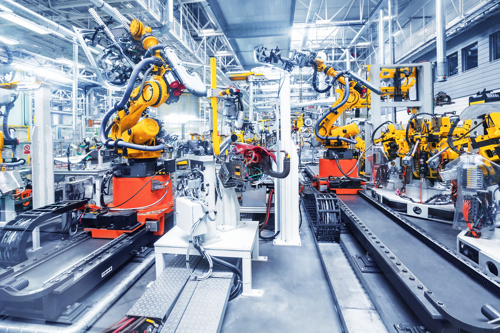
The manufacturing industry relies on production lines involving repetitive tasks, which makes it a natural fit for the adoption of automation and robotics.
And indeed, there has been an acceleration in the use of these tools in recent years as manufacturers seek to streamline operations, create consistency of output, and lessen the cost of and reliance on human labour.
The rise of robotics has been outlined in a report from the International Federation of Robotics, which says that Covid-related supply chain issues have shifted the focus to onshore, automated solutions to fulfil production line needs.
The International Federation of Robotics reports that over 4.28 million industrial robots are now operating in factories worldwide. In 2023, 55,389 robots were installed in the Americas alone.
Alongside the rise in robotics is the rise in ‘cobots’ – the robots designed to work alongside humans for better efficiency, partnered with human intelligence. According to New Zealand’s Callaghan Innovation, the robots are being used for repetitive jobs, which allows staff to be shifted to higher-value tasks. The article also notes that a return is being achieved in 12 months on the popular Universal Robotics Cobot.
IT trends in the manufacturing industry

The Internet of Things is destined to be a major factor in the future of manufacturing, as increasingly sophisticated technology allows machines to connect, share data and improve outputs.
But other trends in this space are also becoming clear. The rise of blockchain and Non-Fungible Tokens is creating opportunities for those in manufacturing to streamline their operations, better track performance, and automate transactions.
As connectivity improves, manufacturers are increasingly turning to digital twins, virtual models of their production lines, to optimise performance and give customers more transparency. With the IoT in manufacturing market projected to reach $673.95 billion by 2032, digital twin adoption is accelerating as businesses look to simulate operations, predict maintenance needs and offer real-time order visibility.
Food Manufacturing Industry Trends 2026

Consumer behaviour has continued to evolve post-pandemic, with long-lasting preferences for convenience, value and transparency. According to PwC’s 2025 Voice of the Consumer survey, shoppers are increasingly choosing food products that align with their personal values, specifically around health, sustainability and animal welfare – pushing manufacturers towards supply chain transparency, environmentally responsible practices and use of cleaner ingredients.
Since the COVID-19 pandemic, consumers have continued to use online ordering platforms and takeaway services. In 2024, Just Eat received 252 million orders in the UK and Ireland.
The shift toward takeout and online ordering has forced businesses to pivot to different systems and invest in digital operations over physical spaces. The demand for paywave or other touch-free payment systems has also increased exponentially, forcing those who hadn’t yet invested in the technology to do so.
Furthermore, the pandemic has focused the food industry and consumers on the need for sustainability, and an understanding of the connectivity of humans, animals and the environment.
While sustainability has been a trend for some years, the pandemic and an increasing number of extreme weather events have meant the issues at play have felt more urgent than ever before. Manufacturers are responding with increasing transparency over supply chains, ensuring the sustainability of products, and offering more packaging products that are recycled or biodegradable.
Electronics manufacturing industry trends
The electronics manufacturing industry has faced the same supply chain disruptions, talent shortage, and sustainability challenges as other subsectors.
Electronic manufacturers are doubling down on automation and hyper-connected production lines to counter ongoing supply chain disruptions and persistent skill shortages. It was expected that by 2025, around 65% of manufactures will be using IoT for processing automation, giving early adopters a significant edge in responsiveness in agile markets.
This, combined with a growing push toward localised suppliers and increased use of 3D printing, is reshaping how electronics products are designed and produced.
Sustainability is also a key focus for the industry. The shift away from global supply chains and towards local supply chains dovetails into the sustainability trend, as it minimises the industry’s carbon footprint and increases the reliance on more sophisticated technology.
Chemical manufacturing industry trends
The chemical manufacturing industry is often slow to evolve compared to others, but it has been forced by the pandemic to move far more rapidly into the digitisation and connectivity that marks the onset of Industry 4.0.
The rise in focus on sustainability and environmentally friendly products is a major focus for the sector, with pressure from the Government, investors and other parties to create a cleaner industry.
Sustainability pressures have intensified as manufacturers head into 2026. Deloitte’s 2025 Chemical Industry Outlook highlights that producers are now prioritising innovation, low‑carbon operations and resilient supply chains to stay competitive. This includes investment in renewable energy, circular economy models and digital tools that support efficiency and regulatory compliance.
Automotive manufacturing trends
In automotive manufacturing, trends which have been on the rise for some time are set to accelerate, often due to legislative changes or private sector support.
Electric or hybrid car purchases are being encouraged by Governments. In New Zealand, for instance, there is a ‘Clean Car Discount’, which provides rebates of several thousand dollars to consumers.
Beyond the rise of electric cars, however, is the movement toward other more environmentally friendly transportation such as public transport, carpooling or electric bikes.
Electrification is now the defining force in automotive manufacturing. The IEA’s Global EV Outlook 2025 shows that more than 17 million electric vehicles were sold worldwide in 2024, with over 20% of all new cars sold now electric. Adoption is even stronger in key markets, EVs account for around 50% of new car sales in China and over 90% in Norway, driving major investment in battery production, lightweight components and EV‑ready supply chains.
Contract manufacturing industry trends
Contract manufacturing is when a business outsources some of its manufacturing requirements to another company. It’s a sector that has seen some benefits from the pandemic, given the restrictions on global movement and labour forces, and the need to look locally for business support.
In particular, the sector has benefited hugely from the uptick in healthcare, with investments into new drugs and therapeutic procedures supporting its growth.
The global contract manufacturing market continues to expand as brands outsource production for greater flexibility and scalability. It is expected to grow from USD 686.4 billion in 2025 to USD 968.7 billion by 2030, at a CAGR of 7.1%, reflecting rising demand across pharmaceuticals, electronics, automotive and consumer goods.
Future trends in manufacturing
If the last few years have shown us anything, it’s how unpredictable the world can be. The trajectory of the pandemic is far from clear, and the manufacturing industry is being forced to adapt to a global situation that remains fluid.
However, some trends will clearly be adopted, albeit at differing speeds. They include:
- Industry 4.0: automation and robotics
The Internet of Things will continue to evolve in Industry 4.0, and smart factories will continue to develop that rely on networks of linked devices.
At the same time, existing technology will be refined, and also become more accessible and widely used – whether it’s cloud software to manage inventory and other data, or robotics on your factory floor
- Focus on sustainability
A focus on sustainability will continue in manufacturing, and consumers will expect evidence of supply chains and/or processes that are environmentally sound and minimise harm.
The trends shaping manufacturing in 2026 demand better visibility, automation and resilience.
Unleashed’s inventory management software helps manufacturers adapt fast with real-time inventory tracking, powerful production features, and connected supply chain insights.
Start your 14-day free trial today.
